
Crown Hair Transplant – Advanced FUE & DHI Hair Restoration
A crown hair transplant, also known as a vertex hair transplant, is a specialized hair transplant procedure designed to treat baldness or thinning in the crown area of the scalp. The crown is one of the most challenging areas to restore because hair naturally grows in a circular or spiral pattern. During the procedure, healthy hair follicles are extracted from the back or sides of the scalp using advanced techniques such as FUE (Follicular Unit Extraction), FUT (Follicular Unit Transplantation), or DHI (Direct Hair Implantation) and implanted into the thinning crown region. Surgeons carefully maintain the angle, direction, and density of the grafts to achieve a natural-looking appearance.
Crown Hair Transplant in Kolkata
- In recent years, Kolkata has become a preferred destination for advanced and affordable hair transplant treatments.
- Many clinics in the city offer modern procedures such as FUE, FUT, and DHI using advanced technology and experienced surgeons. Compared to several metropolitan cities, crown hair transplant procedures in Kolkata are often more cost-effective while still maintaining high treatment standards.
- Patients choose Kolkata not only for affordability but also for personalized care, minimally invasive techniques, and natural-looking results.
Who is an Ideal Candidate for a Crown Hair Transplant?
- An ideal candidate for a crown hair transplant is someone experiencing stable crown baldness with sufficient donor hair available at the back or sides of the scalp.
- Most specialists recommend the procedure for individuals above the age of 25, as hair loss patterns become more stable with age. Candidates should also be in good overall health and have realistic expectations regarding density and final results.
- People with severe donor hair limitations may require a detailed consultation before proceeding with surgery.
Recovery After Afro Hair Transplant
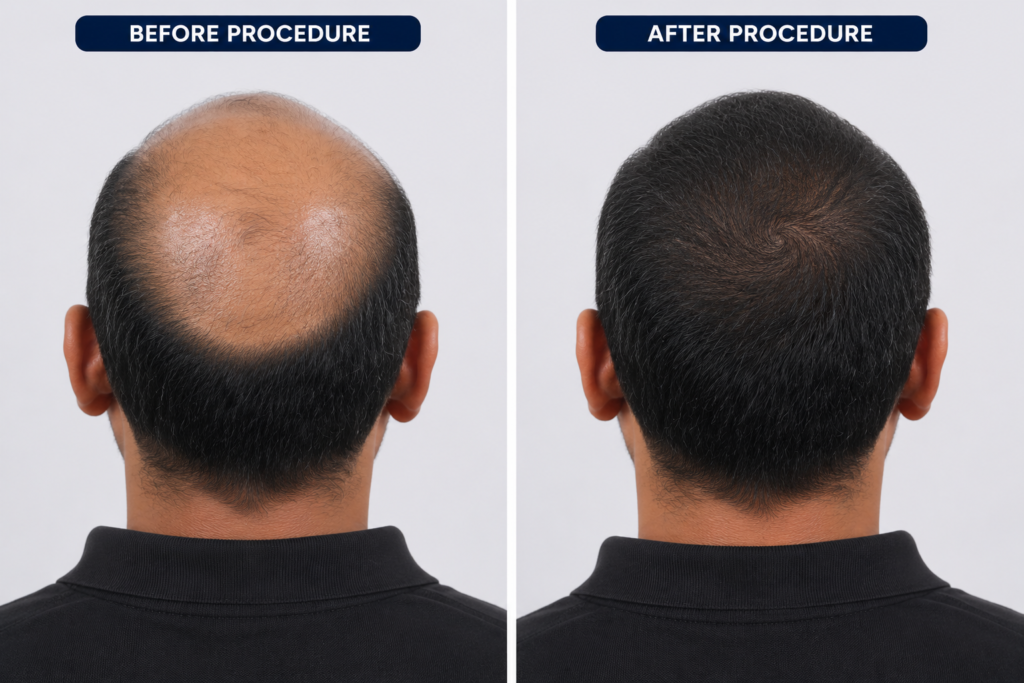
- There are several techniques used for crown hair restoration, with FUT, FUE, and DHI being the most common.
- FUT involves removing a strip of scalp from the donor area and separating it into individual grafts for transplantation.
- FUE is a minimally invasive technique where individual follicles are extracted directly from the scalp using micro-punch tools, resulting in minimal scarring and faster healing.
- DHI, or Direct Hair Implantation, is an advanced method in which hair follicles are implanted directly using a specialized implantation pen for improved precision and natural density.
Crown Hair Transplant Cost
The cost of a Crown Hair Transplant depends on several factors, including the extent of hair loss in the crown area, the number of grafts required, and the technique used, such as FUE or DHI. The surgeon’s experience, clinic reputation, and overall treatment planning can also influence the procedure cost. Since every patient has a different hair restoration need, a proper consultation and scalp analysis are important to determine the most suitable treatment plan and achieve natural-looking results.
Frequently Asked Questions
A Crown Hair Transplant is a specialized hair restoration procedure used to treat hair thinning or baldness in the crown or vertex area of the scalp. In this procedure, healthy hair follicles are taken from the donor area and implanted into the crown region to restore natural hair growth and density.
Yes, a crown hair transplant is generally considered a permanent solution because the transplanted hair follicles are taken from areas of the scalp that are naturally resistant to hair loss. With proper care, the transplanted hair can continue to grow naturally for many years.
FUE and DHI are commonly preferred techniques for crown hair transplant because they provide natural-looking results, minimal scarring, and faster recovery. The most suitable technique depends on the patient’s hair loss condition, donor hair quality, and treatment goals.
The crown area is more challenging to restore because the hair naturally grows in a circular or spiral pattern. To achieve a natural appearance, surgeons must carefully maintain the angle, direction, and density of the implanted grafts during the procedure.
The number of grafts required depends on the size of the bald area, existing hair density, and the desired coverage. A detailed consultation and scalp analysis help determine the exact number of grafts needed for effective and natural-looking results.