
Temple Hair Transplant
Are you looking to restore receding temples and achieve a more balanced, natural-looking hairline? Temple recession can make the hairline appear wider, uneven, and less defined, which may affect overall facial harmony and self-confidence. At Bigderma, we offer advanced temple hair transplant procedures designed to restore natural temple density, refine the hairline, and create soft, natural-looking results tailored to your facial structure and individual hair pattern.
What is a Temple Hair Transplant?
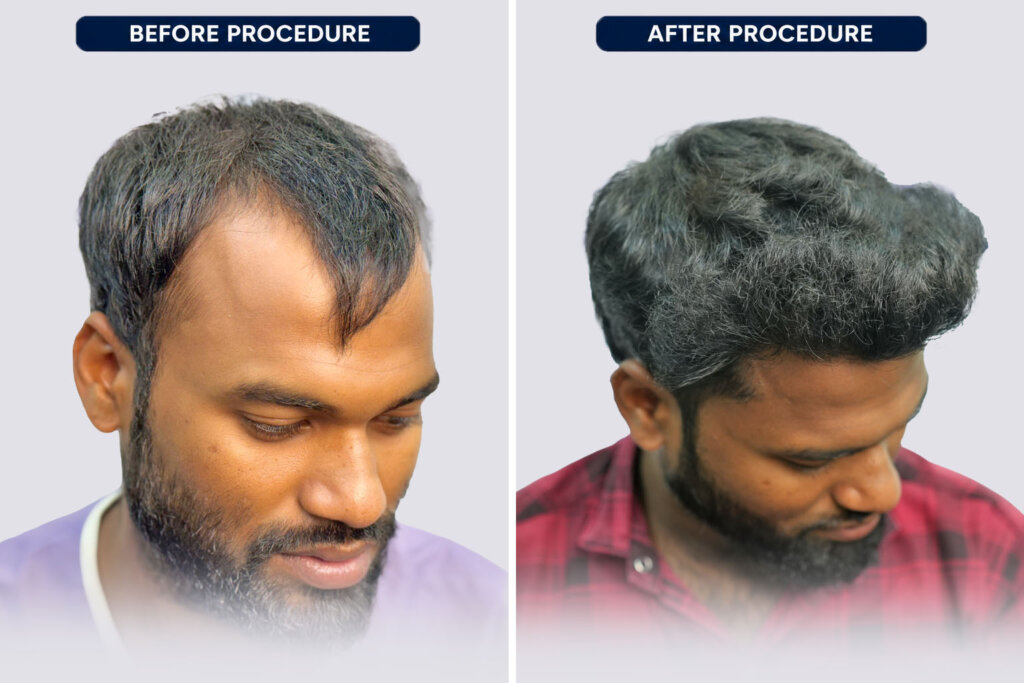
- A temple hair transplant is a specialized hair restoration procedure used to rebuild thinning or receding temple areas. The goal is not just to add hair density, but to create a smooth and natural transition between the frontal hairline and the sides of the scalp.
- The temple region plays an important role in facial framing and overall hairline balance. Since hair in this area naturally grows at flatter angles and in finer patterns, temple restoration requires careful planning, precise graft placement, and attention to natural hair direction.
- During the procedure, healthy hair follicles are usually taken from the back or sides of the scalp, where hair growth tends to be more stable. These follicles are then carefully implanted into the temple area to match the natural angle, direction, and flow of existing hair.
- Modern techniques such as FUE and DHI help achieve softer, natural-looking, and more refined results.
How Temple Hair Transplant Improves Facial Structure and Hairline Balance
The temples play a major role in shaping the overall appearance of the face. Recession in this area can make the forehead appear wider and disrupt the natural flow of the hairline.
Temple hair restoration is often planned to improve:
- Facial symmetry
- Hairline definition
- Frontal hairline transition
- Facial framing
- Overall facial balance
A well-planned temple hair transplant should blend naturally with the existing hairline rather than look artificial or overly straight. Each graft is positioned carefully according to the patient’s facial structure, age, hair characteristics, and natural growth pattern.
Hair direction is especially important in temple reconstruction because temple hairs naturally grow close to the skin at sharp angles. Proper graft placement and spacing help create a soft and seamless transition with surrounding hair.
Single-hair grafts are commonly used in the temple area to maintain finer edges and a more natural appearance.
Who May Need a Temple Hair Transplant?
Temple hair transplantation may be suitable for individuals experiencing thinning or recession around the temples.
Common candidates include:
- Men with temple recession caused by male pattern hair loss
- Individuals with uneven temple areas
- Patients looking to refine the frontal hairline
- Individuals with age-related temple thinning
- Patients with naturally higher temple angles
- Individuals seeking better facial framing and hairline balance
Not everyone with temple thinning requires immediate surgery. A detailed scalp evaluation helps determine whether temple hair transplantation is the right option.
During the consultation, factors commonly assessed include:
- Donor hair density
- Hair texture and quality
- Stability of hair loss
- Existing hairline pattern
- Scalp condition
- Long-term hair restoration goals
A proper consultation also helps set realistic expectations regarding coverage, density, and long-term results.
Temple Hair Transplant Procedure
Temple hair transplantation is usually performed as an outpatient procedure under local anesthesia.
Consultation and Hairline Planning
The procedure begins with a detailed consultation and scalp assessment. During this stage, the surgeon evaluates:
- Temple recession pattern
- Facial proportions
- Existing hairline shape
- Donor area quality
- Estimated graft requirement
- Natural hair direction and temple angles
Careful planning is important because even small changes in the temple area can significantly affect facial appearance.
- Donor Hair Extraction: Healthy hair follicles are extracted from the donor area, usually from the back or sides of the scalp. Advanced methods such as FUE and DHI are commonly used for precise graft selection and minimal visible scarring.
- Recipient Site Preparation:Tiny recipient sites are created in the temple region while carefully matching the natural angle and direction of temple hair growth. This step requires precision because temple hairs generally grow flatter against the skin.
- Graft Implantation: The extracted grafts are implanted strategically to create soft density and natural blending with surrounding hair. Single-hair grafts are often used near the temple edges for a smoother and more feathered transition.
- Recovery and Hair Growth: Most patients return home the same day after the procedure. Mild redness, temporary scabbing, or slight swelling may occur during the early healing period.
In many cases, transplanted hair sheds temporarily within the first few weeks before new growth begins. Visible growth usually starts after several months, while final results continue improving over 9 to 12 months.
Why Choose Bigderma for Temple Hair Transplant?
Temple restoration requires both surgical precision and aesthetic planning. At Bigderma, every temple hair transplant procedure is personalized according to the patient’s facial structure, hair pattern, donor hair quality, and long-term goals.
The focus is on creating natural temple transitions while maintaining harmony between the hairline and facial proportions.
Patients receive:
- Detailed scalp and donor hair evaluation
- Personalized temple and hairline planning
- Advanced FUE and DHI techniques
- Attention to natural graft direction and angulation
- Medically supervised procedures
- Personalized pre- and post-treatment guidance
- Natural-looking and balanced results
With careful planning and refined surgical techniques, temple hair transplantation can help restore a softer, more natural-looking hairline while improving overall facial balance.